Exploring Sensor Precision in Robot Vacuums
The Evolution Of Robot Vacuum Precision
In recent years, robot vacuums have undergone significant advancements. Early models often navigated rooms randomly, frequently missing areas during cleaning cycles. They also struggled with obstacles like thick rugs and stairs, and their operational time was limited.
However, these initial drawbacks have been largely overcome through the use of sensors, efficient motor controllers, and advanced software. These components contribute to improved navigation and more effective cleaning.
Key Sensors in Modern Robot Vacuums
Several sensor technologies play crucial roles in the enhanced performance of today’s robot vacuums.
Ultrasonic Time-of-Flight (ToF) Sensors
Ultrasonic ToF sensors provide precise range measurements, regardless of lighting conditions or the target’s color or transparency. These sensors use a wide field of view to simultaneously measure distances to multiple objects. In robot vacuums, they help detect obstacles like pets or toys, enabling the device to adjust its path to avoid collisions.
Short-Range Ultrasonic ToF Sensors
Short-range ultrasonic ToF sensors can identify different floor types by measuring the amplitude of reflected ultrasonic signals. This allows the robot vacuum to detect transitions between hard floors and carpets, adjusting motor speeds accordingly for optimal cleaning. They also prevent falls.
VSLAM and LiDAR Technologies
Many high-end robot vacuums employ Visual Simultaneous Localization and Mapping (VSLAM) or LiDAR technology to generate virtual maps of a room. These maps enable efficient navigation and comprehensive cleaning of entire home levels. Should the robot be repositioned, it uses wall detection to relocate itself, aligning with the existing map. VSLAM or LiDAR technologies might not be applicable for low-light areas.
Inertial Measurement Units (IMU)
IMUs measure a robot vacuum’s roll, pitch, and yaw, capturing both linear and rotational movements. This data helps the robot maintain accurate positioning and efficient route planning. The IMU allows the robot to recognize if it’s repeating cleaning areas and to resume operations after battery depletion. Crucially, it enables the robot to reorient itself after being moved.
For robot vacuums without VSLAM or LiDAR, dead reckoning, combining wheel rotation measurements, IMU data, and ToF sensor data, defines position and navigation.
Smart Speaker Microphones
With the implementation of AI and voice assistants, microphones are becoming important sensors in robot vacuums. Beamforming, an RF management technique, focuses on the noise signal toward the microphone, enhanced by AI. Future advancements in microphone technology, quieter motors, and beamforming could allow microphones to identify user voices despite background noise.
Algorithms can be trained to recognize commands or prompt the robot vacuum to pause operations when someone speaks, enabling real-time voice control.
Embedded Motor Controllers
Embedded motor controllers ensure precise wheel movement, enabling accurate directional control. This precision is essential for maintaining the robot vacuum’s planned route over time. The controllers can be used on a wide range of sensors.
Pressure Sensors
Pressure sensors assess dust bin fullness by measuring air flow. A drop in air pressure indicates a full bin or a clogged filter. Differential pressure sensors, which measure both internal and external air pressure, improve accuracy. Automatic dust box emptying capabilities, available in some models, allow the robot to empty automatically.
Auto-Recharging Functionality
To accurately measure the battery’s state of charge, current and voltage measurements are needed. Coulomb counters and NTC thermistors within the battery pack provide this information.
When the battery reaches a certain level, the robot vacuum goes back to its last known position and continues cleaning. The device is instructed to return to its base for recharging. With a fully charged battery, it goes back to cleaning.
Thermistors
Thermistors monitor the temperature of the MCU or MPU, motors, and brush gears. If overheating occurs, the system will pause and run system diagnostics tests. Debris in the brushes will overheat the motors, which will create damage.
Furthermore, through diagnostics, the motor’s abnormal noise might indicate early stages of motor degradation.
Cost and Future Trends
The retail price of a robot vacuum often reflects its functionality and accuracy. While high-end models can reach significant price points, more affordable options are also available.
As component costs decrease, expect more mid-tier robot vacuums to enter the market. Technologies like ToF sensors, pressure sensors, IMUs, and motor controllers, coupled with improvements in battery efficiency, will drive this market growth.
Robot vacuum cleaners enhance home cleaning through efficient and effortless technology. With advanced mapping, they’re a popular appliance. They use Simultaneous Localisation and Mapping (SLAM), infrared sensors, and Light Detection and Ranging (LiDAR), to see their environment and create a detailed map.
These maps aid navigation, improve efficiency, and provide complete cleaning.
Mapping improves coverage, allowing the robot vacuum to follow an accurate plan. This ensures no missed spots or overlaps, saving battery life. The map ensures adaptation to different layouts to avoid obstacles and stuck spots. It identifies each room and creates no-go zones for delicate furniture.
Three main mapping technologies exist:
- LiDAR Mapping: Uses lasers for precise maps in any lighting.
- SLAM: Uses cameras for layouts.
- Sensors: Improve accuracy and are suitable for open layouts.
Hybrid mapping technology are used in high-end models.
Robot vacuums using these technologies saves time because intervention is minimized after cleaning cycle. Moreover, the handy app offers complete control and scheduling convenience.
If you’re looking for an efficient robot vacuum, a couple of the best options on the market are:
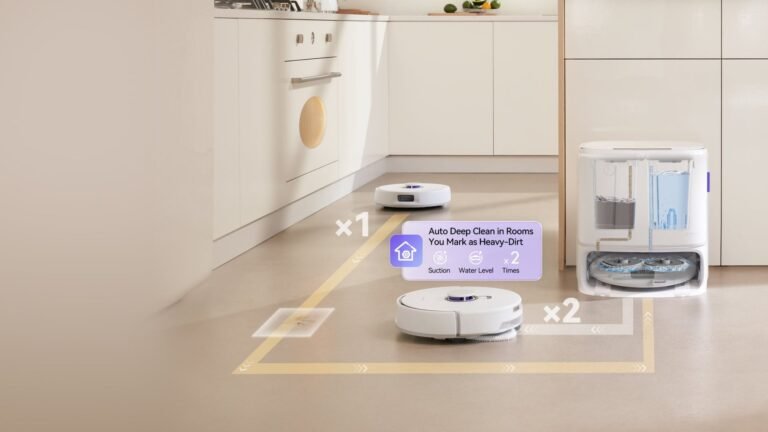
- The Pro Omni Robot Vacuum: This compact robot vacuum offers powerful suction and thorough cleaning, featuring Enhanced TruEdge 2.0 and TruEdge 3D Edge Sensors, AIVI 3D technology aids object avoidance and navigation.
- Robot Vacuum with Multifunctional Dock 3.0: Features LiDAR navigation, AdaptiLift Chassis and an RGB camera and structured light for AI obstacle recognition.
When shopping around, vacuum robots are versatile addition to the modern home, and it depends on your needs:
- Smaller apartments need just a basic model.
- Larger homes can benefit from LiDAR Technology.
- Pet owners can get value from higher suction power.
Virtual wall creations and the ability to store multiple maps are common perks.
The right mapping technology is key to an efficient cleaning solution, with stellar models offering optimal performance.